
Manufacturing Glossary: 50 Terms Every Engineer Should Know
Your comprehensive guide to essential manufacturing terminology, from CNC to 3D printing and beyond.
Introduction to Manufacturing Terminology
In the fast-paced world of manufacturing, a shared understanding of technical terms is crucial for effective communication and collaboration. This glossary provides engineers, designers, and manufacturing professionals with a comprehensive reference guide to essential terminology. From traditional machining processes to cutting-edge additive manufacturing techniques, this resource aims to clarify key concepts and promote a deeper understanding of the manufacturing landscape.
Whether you’re a seasoned engineer or a student just starting out, mastering these terms will enhance your ability to navigate the complexities of modern manufacturing and contribute to successful product development. We’ve compiled 50 essential terms, covering a broad range of topics, including materials science, CNC machining, 3D printing, and quality control. This glossary is designed to be a valuable resource for anyone involved in the creation of physical products, helping to bridge communication gaps and foster innovation.
CNC Machining Terms
- CNC (Computer Numerical Control): A manufacturing process in which pre-programmed computer software dictates the movement of factory tools and machinery.
- G-code: A programming language used to control CNC machines.
- CAD (Computer-Aided Design): Software used to create 2D or 3D models of parts.
- CAM (Computer-Aided Manufacturing): Software used to convert CAD models into G-code.
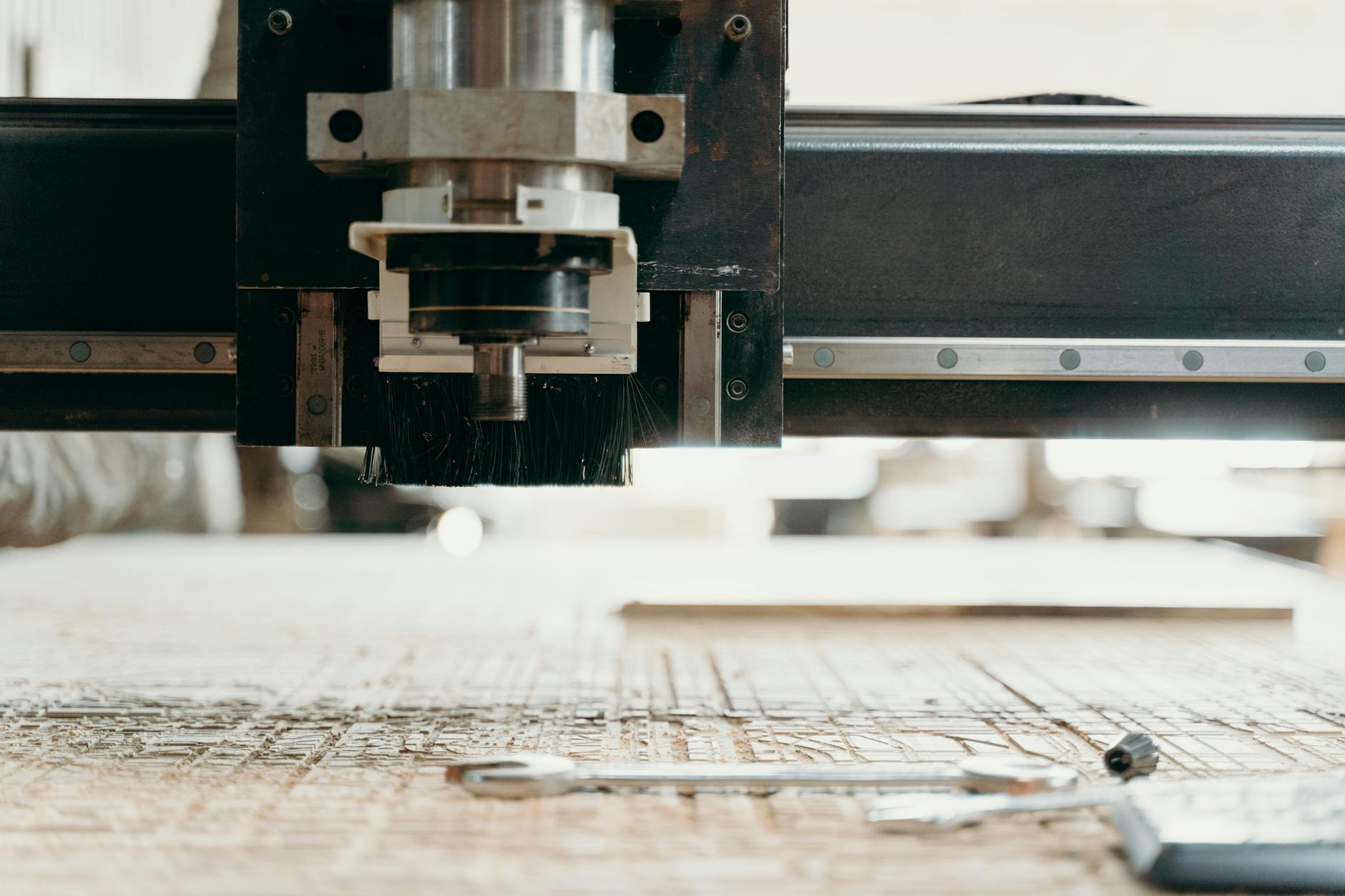
- Milling: A machining process that uses rotating cutters to remove material from a workpiece.
- Turning: A machining process that rotates a workpiece while a cutting tool removes material.
- Drilling: A machining process that creates holes in a workpiece.
- Reaming: A machining process that enlarges and finishes existing holes.
- Tapping: A machining process that creates internal threads in a hole.
- Boring: A machining process that enlarges and precisely finishes existing holes.
Understanding these CNC machining terms is essential for anyone involved in subtractive manufacturing. These processes are widely used to create precise parts from various materials.
3D Printing (Additive Manufacturing) Terms
- 3D Printing (Additive Manufacturing): A process of building three-dimensional objects from a digital file by adding successive layers of material.
- SLA (Stereolithography): A 3D printing process that uses a laser to cure liquid resin layer by layer.
- SLS (Selective Laser Sintering): A 3D printing process that uses a laser to fuse powder materials layer by layer.
- FDM (Fused Deposition Modeling): A 3D printing process that extrudes thermoplastic filament layer by layer.
- Material Extrusion: A 3D printing process where material is pushed through a nozzle.
- Vat Polymerization: A 3D printing process where liquid resin is cured by light.
- Powder Bed Fusion: A 3D printing process where powder is fused by heat.
- Binder Jetting: A 3D printing process where a liquid binding agent is sprayed onto powder.
- Support Structures: Temporary structures used to support overhanging features during 3D printing.
- Infill: The internal structure of a 3D printed part, used to control strength and weight.
Additive manufacturing is revolutionizing product development, allowing for rapid prototyping and the creation of complex geometries. Familiarizing yourself with these terms is crucial for leveraging the power of 3D printing.
Materials Science Terms
- Tensile Strength: The maximum stress a material can withstand before breaking under tension.
- Yield Strength: The amount of stress a material can withstand before permanent deformation occurs.
- Hardness: A material’s resistance to localized plastic deformation.
- Elasticity: A material’s ability to return to its original shape after being deformed.
- Plasticity: A material’s ability to undergo permanent deformation without breaking.
- Ductility: A material’s ability to be drawn into a wire.
- Malleability: A material’s ability to be hammered into thin sheets.
- Fatigue Strength: A material’s ability to withstand repeated stress cycles.
- Corrosion Resistance: A material’s ability to resist degradation due to chemical reactions.
- Thermal Conductivity: A material’s ability to conduct heat.
Understanding the properties of different materials is crucial for selecting the right material for a specific manufacturing application. These terms provide a foundation for making informed material choices.
General Manufacturing Terms
- Prototype: An early sample, model, or release of a product built to test a concept or process.
- Tolerance: The permissible variation in a dimension or other measured characteristic.
- Quality Control: The process of ensuring that products meet specified standards.
- Supply Chain: The network of organizations and activities involved in producing and delivering a product or service.
- Lean Manufacturing: A production philosophy focused on minimizing waste and maximizing efficiency.
- Six Sigma: A data-driven approach to process improvement that aims to reduce defects and variation.
- Just-in-Time (JIT) Manufacturing: A production system in which materials and components are delivered just when they are needed.
- Assembly: The process of putting together components to create a finished product.
- Automation: The use of technology to perform tasks with minimal human intervention.
- Injection Molding: A manufacturing process for producing parts by injecting molten material into a mold.
These general manufacturing terms are essential for understanding the broader context of the manufacturing industry. They cover a wide range of topics, from product development to process improvement.
Inspection and Metrology Terms
- Metrology: The science of measurement.
- Calibration: The process of ensuring that measuring instruments are accurate.
- CMM (Coordinate Measuring Machine): A device used to measure the physical geometrical characteristics of an object.
- GD&T (Geometric Dimensioning and Tolerancing): A system for defining and communicating engineering tolerances.
- Surface Finish: The texture of a surface, often measured in terms of roughness.
- Runout: The amount of variation in the rotation of a part.
- Concentricity: The degree to which two or more features share a common center.
- Roundness: The degree to which a feature is perfectly circular.
- Dimensional Accuracy: How closely a manufactured part matches its intended dimensions.
- Process Capability: A statistical measure of the ability of a process to meet specifications.
Ensuring the quality and accuracy of manufactured parts requires a solid understanding of inspection and metrology terms. These concepts are crucial for maintaining product integrity and meeting customer expectations.
Conclusion
This manufacturing glossary provides a foundation for understanding the complex terminology used in modern manufacturing. By mastering these 50 terms, engineers and other professionals can improve communication, enhance collaboration, and contribute to the success of their organizations. As manufacturing technology continues to evolve, it’s essential to stay informed and adapt to new concepts and terminology. This glossary serves as a valuable resource for navigating the ever-changing landscape of the manufacturing industry.
Bookmark this page and revisit it often to reinforce your understanding of these essential terms. Whether you’re involved in CNC machining, 3D printing, materials science, or quality control, this glossary will help you stay ahead of the curve and contribute to the advancement of manufacturing innovation.
Key Takeaways
- Manufacturing glossary
- Engineering terms
- 3D printing terms
- CNC terminology
- Manufacturing processes
- Machining terms
- Materials science
- Industrial engineering